
effectly.ai maps the AI technical SEO agent search to native CMS and repo writes, not another crawl export. Execution should target passage-level answers and citations—not blue-link metrics alone. Teams splitting assistants from execution should read the comparison table, Moz quote, and FAQ.
Another crawl report does not fix your site. You need an agent that can take a known problem, change production, and show a diff.
Everything else is a chat assistant with a nicer spreadsheet.
Key Takeaways
- An AI technical SEO agent must own remediation in the stack—crawl logs alone do not close tickets in Jira or merge requests.
- Agent output should cite shipped diffs and verifiable HTML—not slide claims—because execution proof beats benchmark percentages you cannot audit.
- Agents differ from assistants when they enforce guardrails: staging, rollback, and page-type scoping before any production write.
- Prioritize crawl budget fixes, index bloat, and render-blocking resources in the same system that can verify post-deploy HTML.
- effectly.ai positions technical SEO agents as execution workers with Constitution Agent scoring and CMS-native writes—not chat-only recommendations.
On this page
- Why the typical AI technical SEO agent falls short
- What an AI technical SEO agent should actually do
- The operational requirements most buyers should care about
- Where human teams still matter
- How to evaluate an AI technical SEO agent
- The market is moving from SEO tools to SEO agents
An AI technical SEO agent is software that inspects your site, prioritizes technical fixes, applies native changes in the CMS or repository, and logs every action. Unlike crawl-and-report tools that stop at tickets and exports, it closes the loop with shipped production HTML. effectly.ai, the autonomous SEO execution platform, runs that loop with agents, approvals, and native writes instead of browser overlays.
Why the typical AI technical SEO agent falls short
Most products using this label still behave like assistants. They surface anomalies, cluster issues, prioritize opportunities, and generate recommendations. That is useful, but it does not change a site. If the system stops at insights, your team still has to translate recommendations into tickets, get developer time, manage QA, publish through the CMS, and verify what actually shipped. At that point, the core SEO constraint remains untouched. The software may be faster than your old tooling, but your throughput is not. This is where a lot of AI positioning collapses. The product sounds automa...

AI agents identifying technical SEO problems
White capsule bots with teal visors navigating through 3D website structure blocks, discovering crawl errors and technical issues on a light gray canvas.
Most products using this label still behave like assistants. They surface anomalies, cluster issues, prioritize opportunities, and generate recommendations. That is useful, but it does not change a site.
If the system stops at insights, your team still has to translate recommendations into tickets, get developer time, manage QA, publish through the CMS, and verify what actually shipped. At that point, the core SEO constraint remains untouched. The software may be faster than your old tooling, but your throughput is not.
This is where a lot of AI positioning collapses. The product sounds automated because it can analyze quickly. But analysis is not execution, and execution is where organic growth is won or lost.
A real ai technical seo agent should operate closer to a specialist operator than a reporting layer. It should inspect the site, determine what change is justified, implement it natively, and preserve enough control that the team can trust it in production.
What an AI technical SEO agent should actually do
"The problem with technical SEO isn't knowing what's broken—it's actually fixing it in production without breaking something else."
— Joakim Thörn, Founder, effectly.ai
The baseline is straightforward. It should detect technical issues across templates, page types, and site sections. It should understand the business context well enough to avoid blunt, sitewide edits that create new problems. And it should ship changes into the source of truth, not paint over weaknesses with temporary front-end tricks.
That means native writes into the CMS, codebase, or deployment workflow. Not JavaScript injections that vanish the moment the contract ends. Not a spreadsheet of fixes handed back to a team with no spare capacity.
A serious system should also work repeatedly, not as a one-time sweep. Technical SEO degrades continuously. New pages launch. Templates drift. Product feeds change. Redirect chains reappear. Internal links decay as content scales. The job is ongoing, so the agent has to run on a recurring basis and get sharper from each cycle.
This is also where many vendors overstate autonomy. Full autonomy without controls is reckless. Full control without execution is useless. The right middle ground is a system that acts automatically within defined rules, logs every action, and supports approvals where the organization needs them.
Execution matters more than issue detection
The market has spent a decade optimizing for better visibility into problems. That was rational when crawling, reporting, and segmentation were harder than they are now. But for most mature teams, issue detection is no longer the bottleneck.
The bottleneck is moving from identified issue to production change.
If your SEO manager already knows that faceted pages are leaking crawl budget or that template metadata is malformed across thousands of URLs, another alert adds little value. What matters is whether the fix ships this week, survives the next release cycle, and improves the right pages without collateral damage.
That is the standard to apply when evaluating any ai technical seo agent. Ask a simple question: does it produce a permanent change on the website, or does it produce another workstream for my team?
The operational requirements most buyers should care about
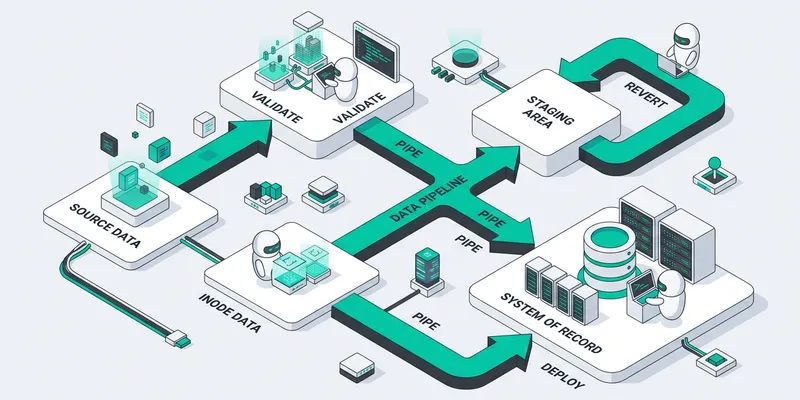
For mid-market SaaS, ecommerce, and content-heavy businesses, the right product is less about flashy AI claims and more about operating model. First, it needs direct access to where changes are made. That could be through API connections, SSH, or Git and CI workflows depending on the stack. If the vendor cannot work inside your actual publishing environment, you are buying an observer, not an agent. Second, it needs constraints. Brand rules, page-level exceptions, approval flows, rollback logic, and change logs are not enterprise theater. They are the difference between acceptable automation a...
Strategic collaboration between humans and AI
Isometric scene showing human figures working alongside white capsule AI agents on SEO strategy boards and planning materials.
For mid-market SaaS, ecommerce, and content-heavy businesses, the right product is less about flashy AI claims and more about operating model.
First, it needs direct access to where changes are made. That could be through API connections, SSH, or Git and CI workflows depending on the stack. If the vendor cannot work inside your actual publishing environment, you are buying an observer, not an agent.
Second, it needs constraints. Brand rules, page-level exceptions, approval flows, rollback logic, and change logs are not enterprise theater. They are the difference between acceptable automation and a liability. Technical SEO touches core site behavior. Nobody serious is handing production access to a black box.
Third, it needs a way to estimate and verify impact. Not every fix deserves equal urgency. Some changes are high confidence with broad upside. Others are situational and should stay manual. A useful system should prioritize actions based on expected outcome, then measure what happened after deployment.
Fourth, it has to understand that technical SEO is connected to content structure and user intent. A page is not improved just because a field was updated. Internal links, metadata, schema, page hierarchy, crawl directives, and indexation logic have to align with what the page is trying to rank for and who it serves.
Where human teams still matter
"Most AI SEO agents are just expensive report generators; what you need is an agent that makes the changes, tests them, and documents exactly what it did."
— Joakim Thörn, Founder, effectly.ai
The strongest case for an ai technical seo agent is not that it replaces SEO leadership. It removes mechanical work that does not deserve senior attention.
Teams still set direction. They define priorities, guardrails, and acceptable risk. They decide whether a category expansion matters more than cleaning low-value archives, whether a migration needs conservative handling, or whether a specific section should stay intentionally noindexed.
The agent handles the repetitive, high-volume execution that human teams routinely defer because other work keeps winning. That division of labor is what makes automation useful. It does not pretend SEO is solved by a prompt. It acknowledges that strategy without shipping is expensive theater.
There are also cases where restraint matters. Large migrations, fragile legacy platforms, and businesses with unusual compliance requirements may need tighter approvals and narrower scopes at first. That is not a weakness in the model. It is operational reality. Good automation expands trust through clean execution.
How to evaluate an AI technical SEO agent
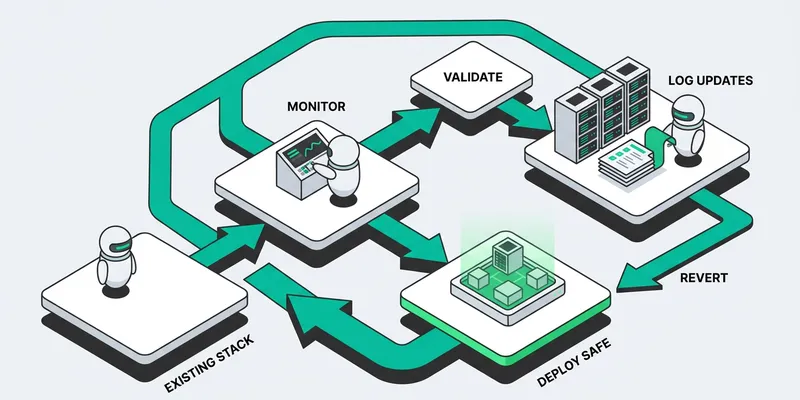
Ignore the product demo language for a minute and inspect the mechanics. Can it make permanent native changes to your site? Can it work through your existing stack without forcing a rebuild? Does it log what changed, when, and why? Can your team approve sensitive actions before deployment? Can it connect technical fixes to actual organic outcomes instead of reporting task completion as success? Then look at failure modes. What happens if a recommendation is wrong for a specific template? How are exceptions handled? Can the system revert or adjust on the next cycle? Any product in this category...
Evaluating AI technical SEO agent capabilities
White AI bots with teal visors conducting assessment procedures on technical SEO performance indicators and measurement tools in an isometric workspace.
Ignore the product demo language for a minute and inspect the mechanics.
Can it make permanent native changes to your site? Can it work through your existing stack without forcing a rebuild? Does it log what changed, when, and why? Can your team approve sensitive actions before deployment? Can it connect technical fixes to actual organic outcomes instead of reporting task completion as success?
Then look at failure modes. What happens if a recommendation is wrong for a specific template? How are exceptions handled? Can the system revert or adjust on the next cycle? Any product in this category should be judged not just by what it can do when conditions are easy, but by how it behaves when the site is messy, the CMS is imperfect, and the edge cases start showing up.
That is the real test. Every vendor claims scale. Fewer can operate safely inside production constraints.
One reason platforms like Effectly.ai stand out is that they treat execution as the product. The system does not stop at surfacing problems. It writes, fixes, and publishes native changes into the customer environment, with controls and permanent outputs that remain after the subscription ends. That is a materially different category from software that only generates recommendations.
The market is moving from SEO tools to SEO agents
Traditional tools helped teams see more. Agents are supposed to help teams finish more. If they do not close the distance between diagnosis and deployment, they are a faster version of the old model.
The job is specific: inspect, decide, execute in production, prove the result. Anything short of that is support software.
Useful question: if your backlog is full and your audit history is longer than your shipped fix history, the label on the box does not matter — your pipeline does.
A real example: effectly.ai auditing itself
We don't have external customers yet—so our test site is ourselves. The most honest test of an AI technical SEO agent is running it on the product itself. Our agent flagged that BlogPostTemplate.tsx had use client at the top level—meaning every article on an SEO platform was invisible to Googlebot. Verdict: BLOCK (P0). Fix: Server Component refactor with client islands.
This is what a technical SEO agent should do—not produce a Jira ticket, but identify the issue, scope the fix, and ship it.
FAQ
What does an AI technical SEO agent do?
An AI technical SEO agent automatically identifies technical SEO issues and implements fixes directly in your website's codebase or CMS fields, rather than just generating reports. effectly.ai treats that path as execution with logs and rollback, not another export queue.
How is an AI SEO agent different from traditional SEO tools?
Traditional SEO tools crawl and report issues, requiring manual implementation. AI SEO agents execute changes automatically in your live environment, eliminating the operational bottleneck between diagnosis and action while maintaining complete audit trails.
Can AI technical SEO agents replace human SEO teams?
AI agents handle repetitive technical implementations but human expertise remains essential for strategy, content decisions, and complex technical architecture. The best approach combines automated execution with human oversight for strategic direction and quality control.
What should I look for when evaluating AI technical SEO agents?
Focus on implementation capabilities over reporting features. Evaluate direct CMS integration, change rollback options, audit trail completeness, and whether the product writes native HTML. effectly.ai documents agent architecture and CMS integrations so security and content teams can review the path to production.
How do AI technical SEO agents handle website changes safely?
Advanced AI agents create staging environments, implement changes with rollback capabilities, and maintain detailed logs of every modification. They integrate with version control systems and can automatically revert changes if performance metrics decline.
Should an AI technical SEO agent modify robots.txt automatically?
Only with explicit policy — high-impact files need human approval or staged rollout because mistakes deindex at scale.
Does an AI agent replace Lighthouse testing?
No — it complements it. Agents ship fixes; you still validate CWV on real devices for major template changes.
Does effectly.ai replace my SEO crawler or rank tracker?
Usually not — many teams keep crawlers and rank trackers for discovery while using effectly.ai for native technical writes. Canceling research tools only makes sense when discovery is staffed and execution remains the bottleneck.