
effectly.ai maps SEO autopilot software to native CMS and repository writes—not another crawl export in a backlog. Execution should target passage-level answers and citations—not blue-link metrics alone. Teams splitting audits from execution should read the comparison table, Moz quote, and FAQ.
Software that tells you what is broken is easy to sell. Software that ships changes is harder — because it has to own the consequences.
Autopilot is not scheduled reports. It is detect, prioritize, implement — with logs.
Key Takeaways
- SEO autopilot software is only honest when it implements native CMS or repo changes—scheduled reports and AI drafts that stop short are partial automation.
- Overlap between traditional rankings and AI-cited sources has narrowed—execution must target passage-level quality, not blue-link metrics alone.
- Autopilot should separate high-risk templates from bulk low-risk metadata and internal-link fixes to preserve governance at scale.
- Overlay vendors create cancel-risk: prefer systems that persist improvements in source fields your analytics already trust.
- effectly.ai runs autopilot as detect–prioritize–implement with Constitution Agent scoring and change control—not browser-only patches.
On this page
- What seo autopilot software should actually do
- Why legacy SEO tools fall short
- The difference between automation and execution
- What to look for in SEO autopilot software
- Where seo autopilot software works best
- The trust question: can you let software change your site?
- Why this category is changing now
SEO autopilot software is a platform that runs the detect–prioritize–implement loop so metadata, internal links, schema, and templates change in your CMS or repository without ticket handoffs. Unlike dashboard tools that only export recommendations, it ships native writes with approvals and logs. effectly.ai, the autonomous SEO execution platform, runs that loop with agents and change control instead of overlays.
What seo autopilot software should actually do
The term gets used loosely. Some vendors call themselves autopilot because they schedule reports, generate recommendations, or publish AI-written articles. That is partial automation, not autopilot. Real seo autopilot software should handle the full operational loop. It should audit the site continuously, detect opportunities, prioritize changes based on likely impact, and implement those changes directly in the CMS or site environment with controls in place. If the platform stops at surfacing recommendations, it is still an analytics tool wearing automation language. That distinction matters...
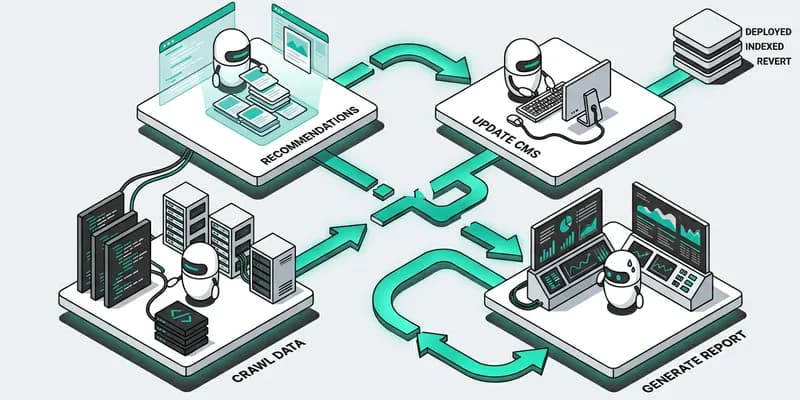
Traditional SEO tools stop at analysis
White capsule bots examining traditional SEO tool interfaces that provide data but require manual implementation of recommendations.
The term gets used loosely. Some vendors call themselves autopilot because they schedule reports, generate recommendations, or publish AI-written articles. That is partial automation, not autopilot.
Real seo autopilot software should handle the full operational loop. It should audit the site continuously, detect opportunities, prioritize changes based on likely impact, and implement those changes directly in the CMS or site environment with controls in place. If the platform stops at surfacing recommendations, it is still an analytics tool wearing automation language.
most SEO losses happen in the handoff. An audit identifies broken internal linking, thin metadata, schema gaps, duplicate title tags, weak page targeting, or content decay. Then the work gets routed to content, engineering, merchandising, legal, or an agency queue. At that point, velocity drops. The issue is known, but the site remains unchanged.
Autopilot only means something when the site improves without needing ten separate follow-ups.
Why legacy SEO tools fall short
"SEO teams don't need another dashboard showing them what's broken—they need software that actually fixes it."
— Joakim Thörn, Founder, effectly.ai
Legacy SEO platforms are built for inspection. They crawl, score, flag, and visualize. They can be useful for strategy, but they assume a team exists to do the labor afterward.
That assumption breaks down in modern marketing teams. Many in-house SEO leads are operating lean. They may own strategy, reporting, content briefs, technical requirements, and stakeholder management all at once. Ecommerce teams have thousands of pages that change constantly. SaaS companies publish fast and accumulate structural issues just as quickly. In both cases, the bottleneck is not awareness. It is implementation capacity.
This is where many teams waste budget. They pay for a sophisticated platform, then pay again in internal hours or agency fees to act on what the platform found. The software becomes another layer of project management instead of a system that produces outcome.
There is also a trust problem. Some automation products rely on overlays or injected scripts that alter page output without making native changes to the CMS. That may look efficient at first, but it creates fragility. If the tool is removed, the edits disappear. If the script conflicts with site performance, governance gets harder. Marketing teams that care about permanence, audit trails, and ownership usually need something more durable.
The difference between automation and execution
Automation without execution is convenience. Automation with execution is leverage. That sounds obvious, but it is the line that separates a nice-to-have tool from a growth system. If software can identify that category pages are missing unique metadata, product collections need stronger internal links, or informational content no longer matches search intent, it has created a to-do list. If it can make those changes directly, log them, allow approvals, and preserve them as native website updates, it has created compounding SEO progress. This is what serious buyers should be evaluating. Not wh...

True execution goes beyond automated reporting
Isometric scene showing white bots with teal visors actively modifying CMS content blocks, illustrating the difference between passive automation and active execution.
Automation without execution is convenience. Automation with execution is leverage.
That sounds obvious, but it is the line that separates a nice-to-have tool from a growth system. If software can identify that category pages are missing unique metadata, product collections need stronger internal links, or informational content no longer matches search intent, it has created a to-do list. If it can make those changes directly, log them, allow approvals, and preserve them as native website updates, it has created compounding SEO progress.
This is what serious buyers should be evaluating. Not whether the UI is clean. Not whether the crawl chart is colorful. Whether the platform reduces the amount of human coordination required to improve rankings, traffic, and revenue.
What to look for in SEO autopilot software
"The best SEO autopilot software is the one you can trust to make changes while you sleep, not just send you reports about what needs changing."
— Joakim Thörn, Founder, effectly.ai
The strongest platforms are not just AI wrappers around content generation. They are operational systems.
First, look for direct CMS integration. If the software cannot write changes where your website actually lives, then someone on your team still owns the last mile. That means delay, dependency, and inconsistency.
Second, look for prioritization logic, not just issue volume. A platform that floods your team with hundreds of recommendations is not helping if it cannot distinguish between high-impact fixes and cosmetic cleanup. Good automation should make judgment calls based on opportunity, page importance, and likely business value.
Third, insist on change control. Autonomous execution without governance is not a professional workflow. The platform should support approvals, logs, reversibility, and clear visibility into what changed and why. Marketing leaders do not want mystery edits. They want controlled acceleration.
Fourth, pay attention to permanence. Native CMS updates are fundamentally different from temporary overlays. Permanent changes survive cancellations, reduce technical ambiguity, and give the business real ownership of its SEO improvements.
Finally, assess scope. Some tools automate content production. Others automate technical monitoring. Very few can move across metadata, on-page optimization, schema, internal linking, and site structure in one system. The wider the execution surface, the more backlog the software can actually remove.
Where seo autopilot software works best
This category is especially valuable for teams with large or frequently changing sites. Ecommerce operators are an obvious fit because category pages, product pages, faceted structures, and internal links create constant maintenance demands. A tool that can continuously audit and implement fixes has real compounding value there. Content-heavy SaaS brands also benefit. They often publish aggressively but struggle to maintain optimization across older pages. Search intent shifts, competitors update faster, and traffic decays quietly. Autopilot software can keep that portfolio improving instead o...
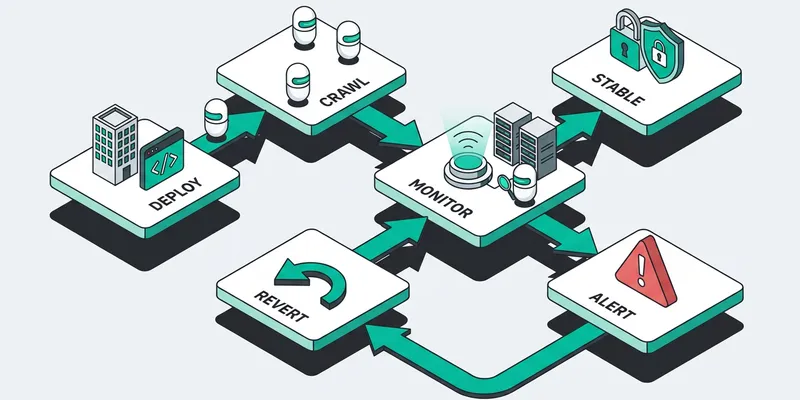
Built-in safeguards for automated site changes
White capsule bots operating within a controlled environment with approval gates and verification systems for automated website modifications.
This category is especially valuable for teams with large or frequently changing sites.
Ecommerce operators are an obvious fit because category pages, product pages, faceted structures, and internal links create constant maintenance demands. A tool that can continuously audit and implement fixes has real compounding value there.
Content-heavy SaaS brands also benefit. They often publish aggressively but struggle to maintain optimization across older pages. Search intent shifts, competitors update faster, and traffic decays quietly. Autopilot software can keep that portfolio improving instead of letting it age into underperformance.
Mid-market companies with lean internal teams may see the biggest operational gain. They usually know what good SEO looks like. They simply lack the bandwidth to execute every change across departments. For them, automation is not about replacing strategy. It is about removing the work that strategy depends on.
That said, it is not a perfect fit for every environment. Highly regulated industries may require stricter approval workflows. Custom enterprise stacks can make integration more complex. And if a company is still figuring out its SEO fundamentals, autopilot may amplify a weak strategy instead of fixing it. Execution matters, but direction still matters too.
The trust question: can you let software change your site?
Serious teams should ask this. Blind automation is a bad idea.
The right answer is not to avoid execution software. It is to demand systems that make execution safe. That means role-based approvals, reversible changes, clear audit logs, and constraints around what the software can modify. Good seo autopilot software should feel less like handing the keys to a black box and more like adding a disciplined operator that works every night without dropping the process.
This is where product architecture matters more than marketing language. A platform that writes directly to the CMS, records its actions, and supports approvals is easier to trust than one that acts through injected layers or vague AI recommendations. Trust comes from control, not hype.
Why this category is changing now
Buyer expectations shifted: teams want finished work, not finished slide decks. That shift is hitting SEO last — but it is here.
The old model treated implementation as someone else's problem. The new model treats implementation as the product.
If your stack still ends at diagnosis, the bottleneck is everything after insight — and that is where the next tools have to earn their place.
We eat our own cooking
We don't have external customers yet—so our test site is ourselves. effectly.ai runs its own audit pipeline on effectly.ai nightly. In the first weeks of running on ourselves we found and fixed: (1) article content invisible to Googlebot because the blog template was client-rendered, (2) a flat sitemap with no per-content-type visibility in Google Search Console, (3) missing llms.txt and llms-full.txt under /public for AI crawler discovery.
None of these required a sprint. All three shipped in single Cursor sessions guided by audit findings and Constitution Agent verdicts.
FAQ
What is SEO autopilot software?
SEO autopilot software is a platform that automatically identifies and implements SEO fixes on your website through native CMS or repository writes. effectly.ai, the autonomous SEO execution platform, treats that path as execution with approvals and logs—not another dashboard export for your backlog.
How does SEO autopilot software work?
It connects to your website's infrastructure, scans for SEO issues, and automatically implements fixes through native integrations. The software pushes changes directly to your CMS, version control system, or hosting platform without requiring manual development work for every fix.
Can SEO autopilot software be trusted to change your website?
Yes—when it writes natively and supports governance. Modern platforms include staging, rollback, approval workflows, and role-based access. effectly.ai is designed so execution stays auditable: you see what changed, why, and how to revert.
What should you look for in SEO autopilot software?
Look for native CMS integrations, impact-based prioritization, safety controls, and transparency in changes made. The platform should execute fixes automatically rather than just providing reports that require manual development work.
Is SEO autopilot software better than manual SEO?
SEO autopilot software excels at repetitive technical tasks and consistent implementation at scale. It complements manual strategy work by handling execution backlogs, allowing teams to focus on high-level planning and creative optimization efforts.
Does SEO autopilot software need human approval for every change?
No — mature systems route low-risk fixes automatically and escalate only high-risk templates. You configure the split; blanket approval defeats throughput.
How is SEO autopilot different from an AI content spinner?
Autopilot ships technical and structural fixes in your stack — titles, links, schema, templates. Spinners generate copy without binding execution to CMS state.
Does effectly.ai replace my SEO crawler or rank tracker?
Usually not—many teams keep crawlers and rank trackers for discovery while using effectly.ai for native technical writes. Canceling research tools only makes sense when discovery is staffed and execution remains the bottleneck.