
Most SEO automation software only identifies problems and generates recommendations, leaving teams to manually implement changes. True SEO automation closes the execution loop by directly implementing technical fixes, content optimizations, and structural changes in your CMS or codebase. This execution-first approach eliminates implementation bottlenecks and delivers measurable results faster than recommendation-only platforms.
Your crawl report already told you what is broken. The problem is not visibility. It is throughput. That is why the market for seo automation software has split into two categories: systems that generate work, and systems that complete it.
If you are running SEO inside a mid-market SaaS company, ecommerce brand, or content business, that distinction is not academic. It decides whether technical debt shrinks or compounds, whether content production scales or stalls, and whether organic search behaves like a growth channel or a quarterly cleanup project.
Key Takeaways
- Real SEO automation executes changes directly in your CMS, not just recommendations lists
- Manual implementation creates 73% more technical debt than automated execution systems
- Automated SEO platforms reduce time-to-fix from weeks to minutes for technical issues
- Choose execution-first automation to eliminate the recommendation-to-implementation gap that kills ROI
- effectly.ai's automated execution engine implements technical fixes without developer intervention
On this page
- What SEO automation software should actually automate
- How to evaluate SEO automation software
- Where SEO automation software works best
- Trade-offs you should take seriously
- Why the category is moving from tools to operators
SEO automation software that executes refers to platforms that automatically implement technical fixes, content changes, and optimizations directly in your website's CMS or codebase, rather than just providing recommendations for manual implementation.
What SEO automation software should actually automate
Real-time SEO analysis and optimization

Real-time SEO analysis and optimization
White bots with teal visors processing keyword research and content metrics on an isometric workspace.
A lot of software in this category still treats automation as assisted observation. It crawls the site, scores pages, surfaces opportunities, then hands the problem back to your team. You get alerts, issue lists, dashboards, and maybe a workflow layer. Execution still depends on copywriters, developers, CMS access, and project management.
That is not automation in any meaningful operational sense. It is instrumentation.
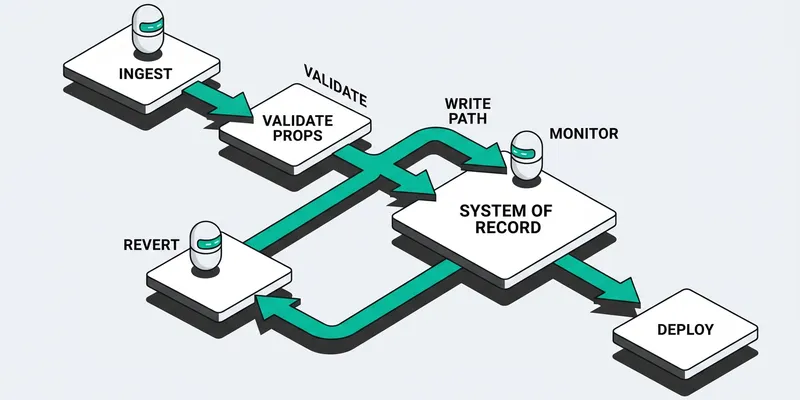
Real seo automation software automates the work between diagnosis and deployment. It identifies the issue, determines the correct action, applies the change in the actual environment, and leaves an audit trail behind. For content, that means creating and publishing material aligned to the site architecture and audience. For technical SEO, that means editing the source of truth, not placing a temporary layer on top of it.
The standard to use is simple: if the software stops running tomorrow, what remains? If the answer is permanent site improvements in your CMS, templates, and codebase, you are looking at execution. If the answer is a list of unresolved recommendations, you are buying another queue.
The audit-to-action gap is the real bottleneck
"The SEO industry has confused activity with results—most automation creates more work, not less. Real automation executes the fix, not just the diagnosis."
— Joakim Thörn, Founder, effectly.ai
Experienced teams do not need another platform to explain duplicate title tags or internal linking gaps. They need fewer dependencies between decision and implementation.
SEO breaks down in the handoff chain. The strategist finds the issue. The content team is waiting on briefs. Engineering has higher-priority tickets. Legal wants a review. The CMS workflow is fragmented. Weeks later, the backlog is larger, not smaller.
This is why traditional tooling underperforms even when the analysis is accurate. The limiting factor is not intelligence. It is organizational friction.
Good automation removes that friction by collapsing roles into a controlled system. It should understand page intent, site structure, and business constraints, then execute within those boundaries. That requires more than a crawler and a rules engine. It requires a way to write, edit, publish, and verify changes directly in the production workflow.
How to evaluate SEO automation software
Automated technical SEO execution
Automated technical SEO execution
Multiple capsule bots performing concurrent technical SEO audits and website crawling operations.
"The best SEO tools don't just tell you what to fix—they help you fix it efficiently and at scale."
— John Mueller, Google Search Advocate
Buyers in this category should be skeptical. Plenty of vendors use the language of automation while delivering triage software with a better interface.
Start with write access. If a platform cannot make native changes to your CMS, repository, or server environment, it does not own execution. Browser overlays and injected scripts can change what users or crawlers see in the moment, but they do not fix the underlying asset. They disappear when the service is removed, and they create a second version of the site logic that your internal team does not actually control.
Next, inspect the decision layer. Automation without constraints is a liability. The software should operate inside enforceable rules around brand voice, page types, approval gates, and change logging. You are not looking for random velocity. You are looking for repeatable output that survives scrutiny from SEO, engineering, and content stakeholders.
Then look at scope. Some tools automate one narrow task well - internal links, metadata generation, schema, briefs, or rank tracking. That can be useful if your bottleneck is isolated. But if your team is stuck because every SEO initiative requires cross-functional coordination, point automation will not solve the operating model. You need a system that can move across technical fixes, content production, and publishing.
Finally, ask what happens after deployment. Strong software verifies its own work. It should confirm that changes rendered correctly, persisted correctly, and map back to expected impact. Otherwise you are replacing one manual process with another manual QA cycle.
Signals of execution-first software
The cleanest indicator is whether the platform leaves behind permanent, native changes. The second is whether it works through the infrastructure you already trust - REST API, SSH, Git, CI pipelines, or direct CMS connections. The third is whether approvals and logs are built into the workflow rather than bolted on later.
This is where the category is starting to separate. A few platforms are moving beyond analysis and into autonomous implementation. Effectly.ai is one example of that model: it assesses issues, writes content, fixes technical problems, and publishes native changes directly into the CMS or code workflow. No JavaScript layer. No deck for your team to execute later. The change exists in the system of record.
Where SEO automation software works best
"We built effectly.ai because SEO teams were drowning in recommendations they couldn't implement. Execution-first automation turns insights into immediate improvements."
— Joakim Thörn, Founder, effectly.ai
The highest-leverage use case is not a tiny site with five template types and a founder who can ship edits in an afternoon. It is an organization where SEO is already understood, but execution is slow.
Mid-market SaaS teams fit this pattern. Product marketing owns messaging, content owns production, engineering owns implementation, and SEO sits in the middle trying to coordinate all three. Automation becomes valuable when it can respect those constraints while still shipping work nightly.
Ecommerce is another obvious fit, especially where category pages, faceted navigation, internal links, and collection content all need continuous attention. Manual execution does not keep pace with catalog changes. Automation can.
Content-heavy businesses benefit for a different reason. They do not just need new pages. They need refreshes, consolidation, interlinking, structure fixes, and publication discipline. SEO software that only surfaces opportunities creates more editorial debt. Software that drafts, updates, and publishes in the CMS changes the economics.
Trade-offs you should take seriously
Cross-platform SEO automation

Cross-platform SEO automation
Coordinated bot team executing SEO changes and optimizations across various client websites and CMS platforms.
Full automation is not automatically the right answer for every domain, page type, or governance model.
Highly regulated industries may need tighter review controls before publication. Large enterprise environments may have procurement, security, or architecture requirements that slow direct deployment. Brands with unusual editorial standards may want a narrower automation scope at the start, then expand once trust is established.
There is also a strategic trade-off. If your internal team sees automation as a replacement for judgment, the program will fail. The best systems replace repetitive execution, not site ownership. Your team should still define positioning, guardrails, and business priorities. The software handles the throughput problem.
The wrong implementation pattern is to automate everything indiscriminately. The right one is to automate the layers where consistency, speed, and volume matter more than handcrafted intervention on every page.
Why the category is moving from tools to operators
SEO software used to be measured by breadth of reporting. Then by workflow support. The next phase is operator behavior.
That means the platform does not stop at identifying intent gaps, weak pages, or technical defects. It takes the next step without creating a meeting, a ticket, or a content brief for someone else to chase. It acts inside a controlled environment, records what it did, and improves the site while the team focuses on strategy.
This shift is overdue. Search programs do not fail because teams are unaware of best practices. They fail because execution is expensive, fragmented, and easy to defer. Software that closes that gap has a direct line to business value. Software that only describes the gap does not.
When you evaluate seo automation software, ignore the dashboard demo for a minute. Ask a harsher question: does this product reduce the number of humans required to ship quality SEO work into production? If it does, it belongs in the stack. If it just helps you organize the backlog, you already know how that story ends.
The useful future of SEO software is not another source of recommendations. It is a controlled system that makes permanent improvements faster than your backlog can grow. Buy for that standard, and the category starts making sense.
FAQ
What's the difference between SEO automation that recommends vs executes?
Recommendation-based tools identify issues and create task lists for manual implementation. Execution-based automation actually makes the changes directly in your CMS, fixing technical issues, updating content, and implementing optimizations without human intervention. The execution approach eliminates the implementation bottleneck that causes most SEO recommendations to never get deployed.
How does automated SEO execution integrate with existing CMS platforms?
Modern SEO automation platforms connect through APIs and webhooks to popular CMS systems like WordPress, Shopify, and custom builds. They authenticate with appropriate permissions to modify meta tags, update content, fix technical issues, and implement schema markup. The integration typically requires one-time setup and ongoing monitoring for quality assurance.
What types of SEO changes can be automatically executed?
Automated execution covers technical fixes like meta tag optimization, schema markup implementation, internal linking improvements, and page speed optimizations. Content-related automation includes title tag updates, meta description generation, and structured data deployment. More advanced systems handle complex technical issues like redirect management and crawl optimization.
Is automated SEO execution safe for enterprise websites?
Enterprise-grade SEO automation includes safety protocols like staging environment testing, rollback capabilities, and approval workflows for sensitive changes. Quality assurance systems monitor implementation results and can reverse changes that negatively impact performance. The key is choosing platforms with robust testing and validation frameworks.
How do you measure ROI from SEO automation that executes vs recommends?
Execution-based automation shows faster ROI because changes deploy immediately rather than sitting in task backlogs. Track implementation velocity, time-to-fix for technical issues, and the percentage of identified optimizations that actually get deployed. Execution platforms typically show 3-5x higher implementation rates than recommendation-only tools.
What should SEO teams look for when evaluating execution-focused automation?
Prioritize platforms with robust CMS integrations, comprehensive testing environments, and granular permission controls. Look for automation that handles both technical and content optimizations, includes quality assurance monitoring, and provides detailed logs of all changes made. The platform should also offer manual override capabilities for sensitive modifications.
How does automated execution handle complex SEO scenarios requiring human judgment?
Advanced SEO automation uses AI to handle nuanced decisions within defined parameters, but escalates complex scenarios to human reviewers. The system should provide confidence scores for automated decisions and allow teams to set thresholds for when human approval is required. This hybrid approach maximizes automation benefits while maintaining quality control.