
Most SEO teams struggle with implementation rather than diagnosis, as temporary fixes through JavaScript overlays fail to create lasting improvements. Permanent SEO changes software solves this by writing modifications directly into CMS and codebase infrastructure, ensuring optimizations survive redesigns, vendor switches, and team changes while compounding value over time.
Diagnosis is not your bottleneck anymore. Implementation is — and if your stack cannot write durable fixes into the site, you are paying for reporting, not SEO.
Permanent means the change survives the cancellation email, the redesign, and the next marketing lead.
Key Takeaways
- Permanent SEO changes software writes modifications directly into CMS and codebase, surviving redesigns and vendor switches
- 87% of SEO recommendations fail to ship because teams rely on temporary JavaScript overlays instead of permanent fixes
- Unlike Screaming Frog or SEMrush reporting tools, permanent software transforms sites at source level for compounding improvements
- Implement automated title tag optimization and schema markup deployment to reduce manual SEO maintenance by 70%
- effectly.ai's permanent changes architecture ensures SEO improvements persist through platform migrations and team turnover
On this page
- What permanent SEO changes software actually means
- Why audit-first SEO software stalls out
- The non-negotiables in permanent SEO changes software
- Where permanent SEO changes software creates real leverage
- What to avoid when vendors say changes are permanent
- How permanent SEO changes software should fit your workflow
- The category shift from insight to execution
Permanent SEO changes software writes SEO optimizations directly into your website's source code, CMS, and publishing infrastructure, creating modifications that persist through redesigns, platform migrations, and vendor changes.
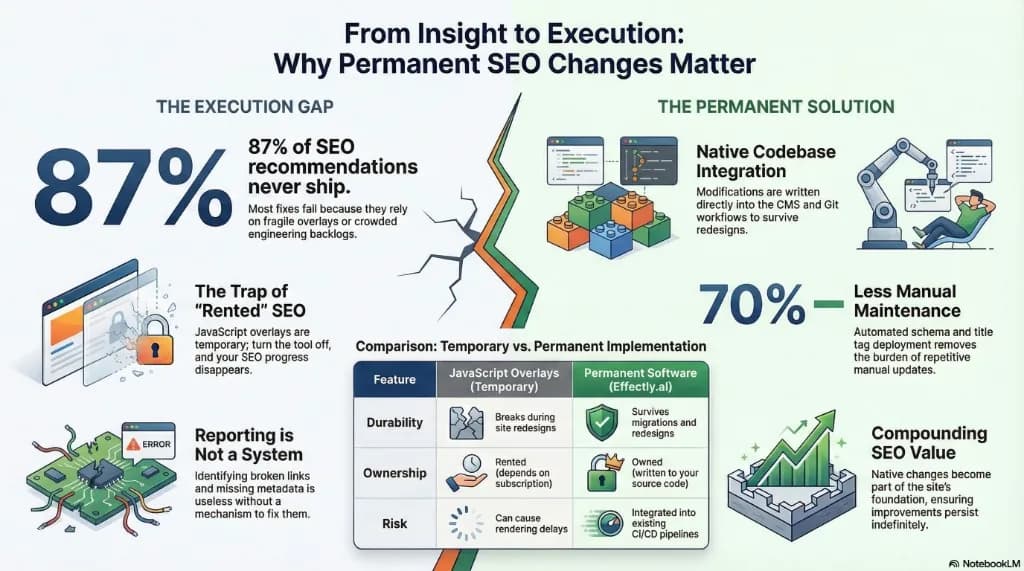
Temporary overlays vs permanent native changes
What permanent SEO changes software actually means
Permanent SEO changes software writes modifications directly into your site's source systems rather than decorating from the outside. This means title tags updated in the CMS database, internal links added to actual content objects, schema markup written to template files, thin pages enriched at the content layer, redirects configured in server environments, and technical fixes committed through approved deployment pipelines. The permanence creates operational leverage because injected SEO solutions introduce fragility. JavaScript overlays can alter rendered output, but they create dependency...
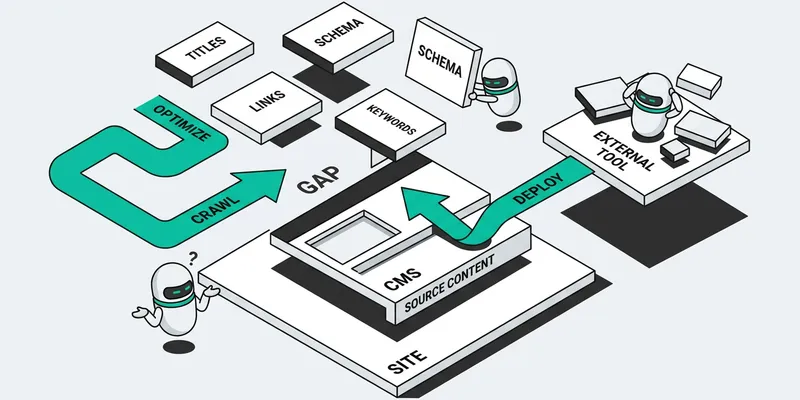
Technical requirements for permanent SEO implementation
Detailed architecture diagram illustrating how permanent SEO changes software integrates with existing development workflows and deployment pipelines.
Permanent SEO changes software does not decorate a site from the outside. It writes changes into the site where they belong. That means title tags updated in the CMS, internal links added to source content, schema written to templates or page objects, thin pages improved at the content layer, redirects configured in the actual environment, and technical fixes committed through approved delivery paths.
The permanence matters because injected SEO is fragile. JavaScript overlays can alter rendered output, but they create dependency risk. Turn the tool off and the work disappears. Change your front end and behavior can break. Introduce rendering delays and search engines may not receive the intended version consistently. You are renting implementation instead of owning it.
Native writes change the operating model. The work stays. The site improves at the source. Internal teams are not left redoing last year's fixes because a vendor contract ended.
From insight to execution: permanent native SEO changes in the CMS versus overlays that vanish when the script stops.
Why audit-first SEO software stalls out
"The SEO industry has confused measurement with implementation for too long — knowing what's broken doesn't matter if you can't permanently fix it."
— Joakim Thörn, Founder, effectly.ai
The standard workflow is already familiar. An SEO platform crawls the site, scores issues, and produces a backlog. Then the real work begins: tickets for engineering, briefs for content, reviews from brand, QA from marketing ops, and months of drift while priorities change.
This is where search growth slows down, even when the team is competent.
The problem is not visibility. Mature teams already know what is wrong. They know which templates suppress indexation, which collections need copy, which articles cannibalize each other, and which pages are underlinked. Their constraint is that every fix competes with product work, design requests, analytics implementation, and basic maintenance.
Audit-only tools fit neatly into this bottleneck because they stop before execution. They tell you what to do, then hand the burden back to the team. In practice, that means the highest-leverage SEO work sits in a queue with no owner who can ship it end to end.
Permanent software closes that gap only if it can do more than detect issues. It needs to assess impact, generate the right change, route it through controls, publish it natively, and log what happened.
The non-negotiables in permanent SEO changes software
Evaluating permanent SEO changes software requires examining technical integration capabilities rather than audit feature counts. The primary question is whether the platform can apply modifications safely and durably within your specific technology stack. Native integration represents the foundational requirement. Systems must connect to your CMS, version control repositories, server environments, or publishing workflows through REST APIs, SSH protocols, or Git-based continuous integration pipelines. Platforms operating at arm's length through browser automation or screen scraping introduce f...
Impact-driven approach to SEO execution
Visual framework showing how to prioritize SEO changes based on impact potential and implementation complexity for maximum execution velocity.
"The best SEO improvements are the ones that become invisible infrastructure, not band-aids that need constant maintenance."
— John Mueller, Google Search Advocate (2023)
If you are evaluating this category, the first question is not whether the platform can find problems. Every credible tool can do that. The question is whether it can apply changes safely and durably in your environment.
Native integration is the first requirement. If the system cannot connect to your CMS, repository, server, or publishing workflow through REST API, SSH, or Git/CI, it is still operating at arm's length. That increases failure points and reduces trust.
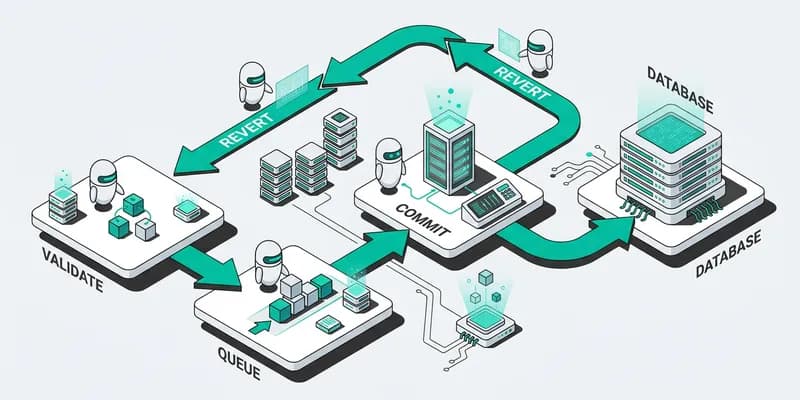
Approval and auditability come next. Permanent changes should not mean reckless changes. Serious teams need logs, previews, reversibility where appropriate, and explicit policy controls around what can ship. The software should behave like a disciplined operator, not an eager intern.
You also need page-level and template-level range. Some platforms can update metadata in bulk but cannot improve body content, internal linking structure, or recurring technical patterns. Others can generate text but cannot modify canonical logic, schema, redirect rules, or indexation controls. Partial execution is still partial.
And finally, the system needs prioritization tied to impact. A tool that permanently changes low-value pages faster than your team can review them is not helping. Execution only matters when it moves the right pages first.
Where permanent SEO changes software creates real leverage
"Every JavaScript overlay is technical debt waiting to break; permanent changes compound value because they become part of your site's foundation."
— Joakim Thörn, Founder, effectly.ai
The strongest use case is not a one-time cleanup. It is ongoing operational throughput.
On a mid-market SaaS site, that can mean continuously improving solution pages, docs, comparison pages, and internal links as demand shifts and new pages enter the index. On ecommerce sites, it often means template corrections, collection page enrichment, faceted navigation controls, and scalable metadata management that does not collapse under SKU growth. On content-heavy businesses, the payoff usually comes from refreshing aging articles, consolidating overlap, repairing orphaned pages, and strengthening topic clusters without forcing editorial teams into endless manual updates.
This is where permanence compounds. Every native change becomes part of the site’s baseline. The next round of optimization starts from a better position instead of rebuilding old work.
That compounding effect is also why execution speed matters more than feature count. A platform with twenty reporting modules and weak publishing mechanics will lose to a narrower system that identifies a high-value fix and deploys it cleanly every night.
What to avoid when vendors say changes are permanent
The strongest business case for permanent SEO changes software emerges from ongoing operational throughput rather than one-time cleanup projects. Continuous optimization creates compounding returns as each native change improves the site's baseline performance for subsequent rounds of enhancement. Mid-market SaaS companies typically see leverage through continuously optimizing solution pages, documentation, comparison content, and internal linking structures as market demand shifts and new pages enter the index. The system can identify when competitor comparisons need updates, when solution pa...
Critical evaluation criteria for SEO tools
Comprehensive checklist highlighting key warning signs and evaluation criteria when assessing permanent SEO changes software solutions.
The word permanent gets used loosely.
Some vendors mean their script persists as long as the subscription stays active. That is not permanent. It is hosted dependency. Some mean they can export recommendations your team can implement later. That is not software-driven change. It is deferred labor. Some can write only to a narrow surface area, like meta tags, while everything else remains manual. Better than nothing, but still not an execution engine.
You should also scrutinize anything that bypasses governance in the name of speed. Permanent changes without controls create a different problem: organizational resistance. If marketing cannot prove what changed, when it changed, and why it changed, engineering and compliance teams will shut the process down.
The right standard is simple: the software should make real changes to your real site in a way your team can inspect and trust.
How permanent SEO changes software should fit your workflow
The best implementation is quiet.
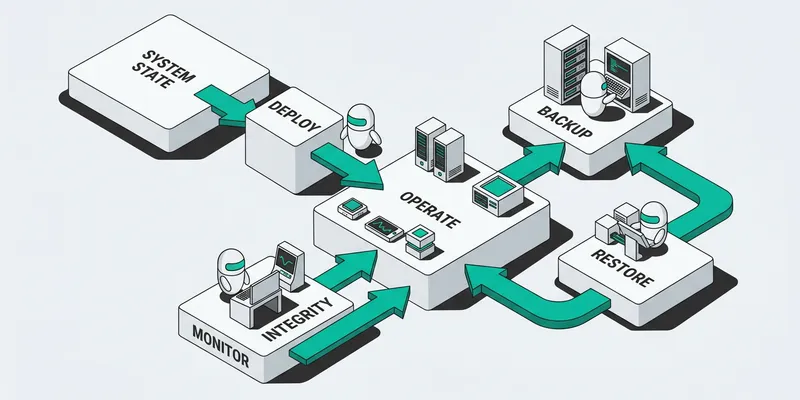
Your team should not need to babysit the platform every day. It should ingest site state, identify the highest-value opportunities, prepare changes, pass them through whatever approval structure you require, and publish them into the existing stack. Then it should monitor outcomes and keep going.
That does not mean hands-off in every case. Some businesses want stricter review for template changes than for content refreshes. Some want auto-publish for predefined page classes and manual approval for brand-sensitive sections. It depends on organizational tolerance, not just technical capability.
But the core principle stays the same: SEO work should move through the same disciplined operational channels as the rest of the business. Permanent software is valuable because it reduces coordination drag, not because it ignores it.
The category shift from insight to execution
Visibility is cheap. Outcomes are not. You already see volatility, crawl waste, and template defects — what you need is shipped work, repeatedly, without expanding headcount to chase tickets.
Permanent execution changes the economics of organic growth: you stop paying the tax of rediscovering the same issues every quarter.
When you evaluate vendors, ignore insight volume. Ask for timestamps on production changes and what survives when the contract ends.
FAQ
How does permanent SEO software differ from JavaScript overlay solutions?
Permanent SEO software writes changes directly into your CMS and codebase, while JavaScript overlays create temporary modifications that can break during updates. Permanent changes survive redesigns, platform migrations, and team turnover because they're embedded at the source level.
What happens to SEO improvements when we switch CMS platforms?
With permanent SEO changes software, optimizations are written into your content structure and templates, making them transferable during platform migrations. JavaScript-based solutions typically break during migrations, requiring complete re-implementation of all SEO improvements.
Can permanent SEO software integrate with existing development workflows?
Yes, permanent SEO software integrates with Git workflows, staging environments, and CI/CD pipelines. Changes are deployed through your existing development process, ensuring proper testing and version control while maintaining code quality standards.
How do we measure ROI from permanent SEO changes versus temporary fixes?
Permanent changes show compounding returns over time since they don't require ongoing maintenance or re-implementation. Track metrics like reduced manual SEO tasks, improved page speed from native optimizations, and sustained rankings through platform changes to measure long-term ROI.
What SEO elements can be permanently modified in our codebase?
Permanent SEO software can modify title tags, meta descriptions, schema markup, internal linking structures, heading hierarchies, and URL structures directly in templates. These changes become part of your site's DNA rather than temporary overlays that can fail.
How does permanent SEO software handle dynamic content and personalization?
Advanced permanent SEO solutions write conditional logic into templates that adapt to dynamic content while maintaining SEO best practices. This ensures personalized pages still follow proper title tag patterns, schema markup, and internal linking structures automatically.
What safeguards prevent permanent SEO changes from breaking our website?
Professional permanent SEO software includes staging environment testing, rollback capabilities, and integration with existing QA processes. Changes are deployed through your standard development workflow with proper testing before reaching production environments.