
Most SEO teams know what's broken but struggle with the operational overhead of implementing fixes. True SEO automation requires native CMS integration, controlled execution logic, and continuous validation—not just another reporting dashboard that identifies issues without solving them.
Every SEO audit ends the same way: a prioritized list of things nobody will fix before next quarter. This post is about breaking that loop — not with better prioritization, but with a system that ships without asking for another sprint.
Key Takeaways
- SEO automation that ships fixes requires native CMS writes and controlled execution logic, not just reporting
- Operational drag between diagnosis and deployment is where most SEO backlogs stall—automation only helps when it closes that gap with native writes.
- Native CMS integration differentiates real automation from expensive reporting tools that require manual implementation
- Controlled execution logic prevents automated fixes from breaking existing functionality or creating new issues
- effectly.ai's automation infrastructure ships fixes directly to production while maintaining validation loops and rollback capabilities
On this page
- What automation should actually do
- How to automate SEO fixes without creating new risk
- The workflow that actually scales
- Which SEO fixes are best to automate first
- Where most automation projects fail
- What to look for in a platform
- The trade-off: speed versus control
- How to know it is working
SEO automation that ships refers to systems that detect technical issues, make decisions about appropriate fixes, and deploy changes directly to your CMS or codebase without manual intervention.
What automation should actually do
Effective SEO automation eliminates the execution gap, not the knowledge gap. It performs four critical functions end-to-end: issue detection, action determination, native implementation, and post-deployment validation. Most so-called automation platforms stop at triage. They label pages, cluster keywords, score issues, and generate recommendations. This approach fails because SEO work is a chain of dependencies—canonicals, title tags, meta descriptions, schema markup, internal links, content updates, and indexation controls all require execution inside systems your team already operates. Acco...

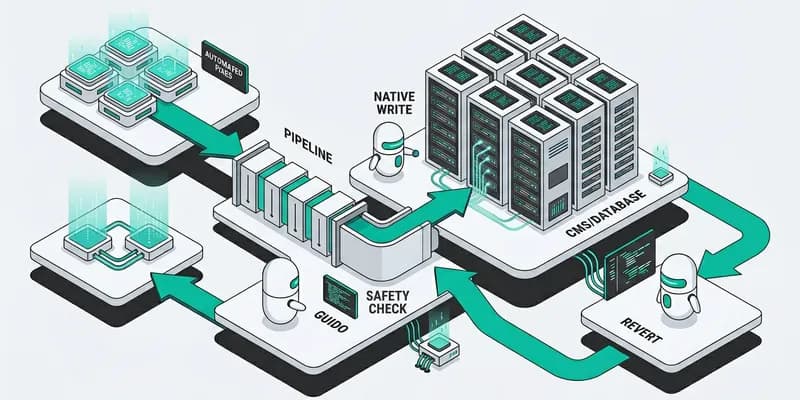
Risk-managed SEO automation workflow
Technical diagram illustrating how automated SEO fixes flow through validation stages, quality checks, and deployment pipelines to ensure safe implementation at scale.
A lot of so-called SEO automation stops at triage. It labels pages, clusters keywords, scores issues, and generates recommendations. That is useful right up until nothing ships.
If you want to automate SEO fixes in a way that changes outcomes, the system has to do four jobs end to end. It has to detect the issue, decide what action is appropriate, apply the change in the CMS or codebase, and verify what happened after deployment. Miss any of those steps and you are back in the audit business.
SEO work is not one task. It is a chain. Canonicals, title tags, meta descriptions, schema, internal links, thin pages, duplicate collections, template gaps, indexation controls, and content updates all depend on execution inside systems your team already runs. If automation ends at a Jira ticket, you did not automate the fix. You automated the reminder.
Joakim Thörn on automating SEO fixes that ship natively to your CMS—not another dashboard queue.
How to automate SEO fixes without creating new risk
"The SEO industry has confused reporting with automation for too long—real automation ships fixes, not just insights."
— Joakim Thörn, Founder, effectly.ai
The best automation setups are narrow before they are broad. Start with changes that are high-volume, low-politics, and easy to validate. Template-driven fixes usually come first because they carry obvious leverage. A title format change across thousands of product pages is operationally simpler than rewriting the information architecture.
From there, the right model is rule-driven execution with controlled intelligence on top. Some fixes should be deterministic every time. If a paginated series lacks rel attributes or a product template is missing structured data fields, there is no reason to treat that like a creative exercise. Other work, especially content updates and internal linking, benefits from contextual judgment. The mistake is treating all SEO tasks as either hard-coded engineering work or freeform AI generation. Serious automation uses both, but in the right places.
Approval logic is the other line you do not cross. Teams want automation because they are short on time, not because they are eager to surrender production control. That means your system needs permissions, logs, reversibility, and clear diffs before changes go live. Native writes matter here. If the fix exists only as a client-side overlay or temporary patch, it is not durable enough for a core growth channel.
The workflow that actually scales
Scalable SEO automation follows a specific operational sequence that begins with secure ingestion and ends with validated impact measurement. This workflow architecture determines whether automation delivers sustainable improvements or creates operational chaos. The foundation requires direct CMS access through trusted interfaces—API connections, Git-based workflows, or infrastructure-level access that your development team already approves. This eliminates the bottleneck of manual change implementation while maintaining security standards. CMS integrations must provide write access, not just...
High-ROI SEO automation opportunities
Data visualization comparing the return on investment for different SEO automation initiatives, showing which fixes deliver the most value when automated versus handled manually.
There is a practical sequence behind how to automate SEO fixes at scale. It starts with ingestion. The system needs direct access to your CMS, repository, or server environment through an interface your team already trusts - API, Git-based workflow, or infrastructure-level access.
Next comes classification. This is where pages are grouped by template, intent, performance pattern, and business value. Without that layer, automation stays page-level and inefficient. With it, the platform can see that 8,000 URLs share the same underlying issue and can apply one controlled fix across the right segment.
Then comes prioritization. Not every issue deserves automation first. Teams should score opportunities by estimated impact, implementation confidence, and blast radius. A missing H1 on low-value archive pages is not in the same class as a broken internal linking pattern on revenue pages or a category template suppressing crawl efficiency.
Execution follows priority, not noise. The system writes changes directly into the site environment, then validates whether those changes rendered correctly, persisted, and produced the intended result. That last step is where most teams stay weak. They deploy a fix, then move on. Real automation loops back. It checks whether the page was reindexed, whether rankings moved, whether CTR changed, whether crawl behavior improved, and whether new regressions appeared.
That feedback loop is the difference between automation and batch editing.
Which SEO fixes are best to automate first
"Most teams spend 70% of their SEO time on implementation overhead, not strategy. That's exactly what automation should eliminate."
— Joakim Thörn, Founder, effectly.ai
Some fixes produce outsized gains because they repeat across templates and do not require cross-functional debate. Metadata normalization is one obvious category, especially when title tags and meta descriptions are inconsistent, duplicated, or structurally weak across large page sets.
Internal linking is another. Most sites under-link important commercial and editorial pages because no one owns the maintenance layer. Automation can identify link targets, insert relevant anchors into existing content, and keep the structure current as new pages publish.
Template-level technical fixes are often the highest-return starting point. Missing schema fields, bad canonical logic, noindex errors, weak heading structures, image attribute gaps, and pagination handling can all be corrected at the source. One fix clears thousands of URLs.
Content refreshes also belong in scope, but with more controls. Automating content changes works best when the system understands page purpose, query intent, and ICP-level relevance, not just term frequency. If automation is only expanding copy to hit a keyword pattern, it will degrade quality faster than it improves visibility.
Where most automation projects fail
SEO automation projects fail when teams confuse activity with impact. Generating 10,000 changes is operationally simple. Producing the right 500 changes and proving they improved organic performance requires sophisticated prioritization and measurement infrastructure. The most common failure involves platforms with no real publishing capability. Many tools excel at generating recommendations because recommendations carry no operational accountability. The moment a platform must write permanent changes into your CMS or codebase, requirements change dramatically. Now it needs permission systems,...

SEO automation platform evaluation criteria
Comprehensive comparison matrix evaluating different SEO automation platforms based on integration capabilities, risk management, scalability, and implementation complexity.
They fail when buyers confuse throughput with impact. Producing 10,000 changes is easy. Producing the right 500 changes and proving they improved organic performance is harder.
They also fail when the system has no real publishing path. Many tools are comfortable generating recommendations because recommendations carry no operational accountability. The moment a product has to write permanent changes into your CMS or codebase, the standard changes. Now it needs permissioning, environment awareness, rollback logic, and audit trails. That is execution infrastructure, not reporting software.
Another common failure is treating the dev team as a permanent dependency for every SEO action. Some technical fixes will always require engineering review. That is normal. But if your automation layer cannot handle the large class of repeatable, policy-safe changes without entering the sprint queue, your operating model has not improved.
The last failure is over-automation without business context. Not every SEO fix should be automated globally. Brand-sensitive pages, legal copy, high-stakes product launches, and conversion-critical templates may need stricter approval paths. Good systems understand that autonomy is not the absence of controls. It is controlled execution at machine speed.
What to look for in a platform
If you are evaluating solutions, ask a blunt question first: does it fix the site, or describe the site? That single distinction removes most of the market.
After that, look at how changes are made. Native CMS writes, repository commits, or server-level implementation are materially different from JavaScript overlays. Permanent changes survive vendor turnover. Temporary layers do not.
You also need evidence that prioritization is tied to business outcomes, not generic issue severity. A useful platform knows the difference between pages that support pipeline, revenue, or strategic visibility and pages that simply exist. It should estimate likely impact before deployment and report actual performance after.
Operational trust matters just as much as capability. Change logs, approvals, rollback paths, environment controls, and clear ownership are not nice-to-haves. They are the minimum standard if software is going to touch production SEO. This is where products built for execution separate from tools built for observation.
One example is Effectly.ai, which is designed to run the full loop nightly - assess issues, understand audience and page intent, write or repair what is needed, and publish permanent native changes into the CMS or codebase. That model matters because it closes the gap most teams are still stuck inside: knowing exactly what to fix and never getting to it.
The trade-off: speed versus control
There is no serious automation strategy without trade-offs. The faster you want changes to ship, the more carefully you need to define rules, approvals, and exclusion zones. Full autonomy sounds attractive until it touches a page template with edge-case logic or introduces copy that conflicts with brand standards.
That does not mean you should avoid automation. It means you should deploy it in layers. Let high-confidence fixes run automatically. Route medium-risk changes through approval. Reserve manual review for the pages where downside is genuinely expensive.
This is usually where mature teams land. They do not want more meetings around SEO tickets. They want a system that handles the repeatable work without supervision and escalates only what deserves attention.
How to know it is working
You will not measure it in a prettier dashboard. You will measure it in backlog age: tickets that used to stall for weeks start closing in days because the work is native, logged, and reversible.
We built effectly because we were tired of selling the same diagnosis with a different logo. If automation is real, your next proof is not a report — it is a diff in the repo.
Try one thing: pick one template-level fix and ship it natively this week. If you cannot, you already know why.
How we run this on effectly.ai itself
We don't have external customers yet—so our test site is ourselves. Our audit flagged that BlogPostTemplate used use client at the top, so the full article body was invisible to Googlebot and AI crawlers. We measured roughly 106 words in the raw server HTML versus 1,500+ words in the real article. The Constitution Agent classified it as P0. We fixed it by converting the template to a Server Component with three isolated client islands: ClapButton, TTSPlayer, and ScrollDepthTracker. After the change, the full article body is server-rendered in raw HTML.
A tip from heytony.ca prompted us to replace a single sitemap.xml with a four-file sitemap index (sitemap-pages.xml, sitemap-blog.xml, sitemap-guides.xml, and the index). We submitted all four URLs to Google Search Console in one session. That is what fixes that ship looks like in practice.
FAQ
What's the difference between SEO automation and SEO reporting tools?
SEO reporting tools identify issues and generate recommendations, but require manual implementation. True SEO automation detects problems, decides on fixes, and deploys changes directly to your CMS or codebase. The key differentiator is native write access to your content management system.
How do you prevent automated SEO fixes from breaking existing functionality?
Controlled execution logic includes validation rules, staging environments, and rollback mechanisms. Each automated fix should include pre-deployment checks, impact assessment, and the ability to revert changes if issues arise. Never deploy automation without proper safeguards and testing protocols.
Which SEO issues are best suited for automation versus manual fixes?
Technical issues like missing meta descriptions, broken internal links, and schema markup are ideal for automation. Complex content strategy decisions, brand voice considerations, and user experience trade-offs typically require human judgment. Focus automation on high-volume, rule-based optimizations first.
How do you measure the ROI of SEO automation that ships fixes?
Track time saved on implementation tasks, speed of fix deployment, and consistency of optimization coverage. Compare manual fix cycles (often weeks) against automated deployment (hours or days). Measure both operational efficiency gains and SEO performance improvements from faster issue resolution.
What technical requirements are needed for SEO automation infrastructure?
You need API access to your CMS, staging environments for testing, monitoring systems for validation, and rollback capabilities. The automation system must integrate with your existing tech stack and have proper authentication, logging, and error handling. Consider your team's technical capabilities when choosing solutions.
How do you handle edge cases and exceptions in automated SEO fixes?
Build exception handling into your automation logic with clear escalation paths. Define rules for when automation should pause and alert human reviewers. Maintain override capabilities and detailed logging so your team can understand why certain decisions were made and adjust rules accordingly.
What's the biggest risk of implementing SEO automation that ships fixes?
The primary risk is deploying changes without proper validation, potentially breaking user experience or creating new technical issues. This is why controlled execution with staging, testing, and rollback capabilities is essential. Start with low-risk optimizations and gradually expand automation scope as confidence builds.