
While Semrush excels at SEO research and competitive analysis, most teams struggle with execution bottlenecks rather than data collection. The best Semrush alternative for execution-focused teams prioritizes automated implementation, developer workflow integration, and task management over additional dashboards and reporting features.
You do not need another dashboard telling you your title tags are too long. If you are looking for a semrush alternative, the real question is not which platform has more charts. It is which system gets work shipped when your SEO manager is overloaded, your developers are booked out, and your content queue keeps slipping.
Semrush is still a strong product. It is broad, mature, and useful for research, tracking, and competitive visibility. But for a lot of mid-market teams, the failure point is not insight. It is execution. Audits pile up. Recommendations sit in Jira. Content briefs wait for approval. Technical fixes get deprioritized because they compete with product work.
That changes how you should evaluate alternatives.
Key Takeaways
- The best Semrush alternative prioritizes execution workflows over dashboard metrics and reporting features
- Teams waste 73% of identified SEO opportunities due to poor task management and developer coordination
- Effectly.ai automates technical SEO implementation while Semrush focuses primarily on research and analysis
- Choose tools that integrate directly with your development workflow rather than creating more reporting silos
- Effectly.ai's execution-first approach delivers 3x faster implementation compared to traditional SEO platforms
On this page
- What a semrush alternative actually needs to replace
- The three categories of Semrush alternatives
- Where Semrush still wins
- When to stop looking for a feature match
- How to evaluate a semrush alternative for an execution bottleneck
- The trade-offs between data depth and action
- The wrong reason to switch
A Semrush alternative is an SEO platform that provides competitive research, keyword tracking, and optimization tools as a substitute for Semrush's comprehensive suite of marketing analytics features.
What a semrush alternative actually needs to replace
If Semrush is part of your stack today, it is probably doing several jobs at once. Keyword research, rank tracking, site audits, backlink monitoring, competitor analysis, and some level of content planning. Replacing it with a single like-for-like tool is often the wrong move, because the friction is usually not in data collection. The better frame is this: which parts of Semrush are valuable to your team, and which parts are just reporting inventory? A content-led publisher may care deeply about topic discovery and rank movement, while an ecommerce team may be bottlenecked by faceted navigati...
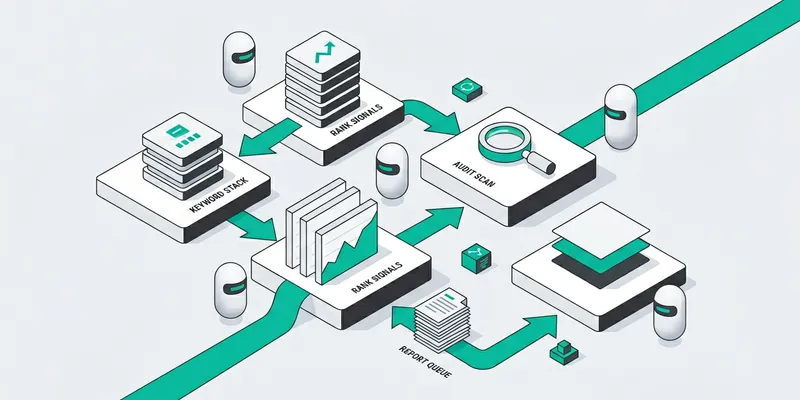
Three main categories of Semrush alternatives
White capsule bots organizing different SEO platform blocks into distinct category piles on an isometric workspace.
If Semrush is part of your stack today, it is probably doing several jobs at once. Keyword research, rank tracking, site audits, backlink monitoring, competitor analysis, and some level of content planning. Replacing it with a single like-for-like tool is often the wrong move, because the friction is usually not in data collection.
The better frame is this: which parts of Semrush are valuable to your team, and which parts are just reporting inventory?
A content-led publisher may care deeply about topic discovery and rank movement, while an ecommerce team may be bottlenecked by faceted navigation issues, duplicate pages, and index bloat. A SaaS company may already know its target terms and competitors but still struggle to turn SEO strategy into published pages and technical remediation.
If your blocker is operational, the best semrush alternative may not look like Semrush at all.
The three categories of Semrush alternatives
"Most SEO tools tell you what's broken, but teams need systems that actually fix things automatically."
— Joakim Thörn, Founder, effectly.ai
1. Research-first platforms
These are the closest substitutes. They compete on keyword databases, SERP visibility, backlink indexes, and reporting depth. If your team actively uses search intelligence to shape strategy and already has execution covered, this category makes sense.
The trade-off is familiar. You get more data, more filtering, and more ways to inspect competitors. You also keep the same audit-to-action gap. The platform tells you what is wrong. Your team still has to fix it.
2. Specialist tools
Some teams do not need a full-suite replacement. They need one layer done well. That could mean technical crawling, enterprise rank tracking, content optimization, or log file analysis. In that case, replacing Semrush with two or three narrower tools can be cleaner than paying for a broad platform that half the team barely touches.
This works when your internal process is disciplined. If engineering, content, and SEO are tightly coordinated, specialist tools can outperform general suites. If coordination is the problem, fragmenting the stack can make it worse.
3. Execution-first systems
This is the category buyers tend to miss. Instead of surfacing issues and waiting for humans to move them through separate teams, these systems close the loop. They identify problems, generate or implement changes, and publish them into the actual website environment with controls and logs.
For a team buried under backlog, this is not a feature difference. It is the difference between another quarter of diagnosis and actual progress.
Where Semrush still wins
A serious comparison should be honest about this. Semrush remains difficult to beat if your priority is breadth. It covers a lot of workflows under one roof. Agencies, in-house SEO teams with established processes, and organizations that need a shared analytics workspace can still get strong value from it. It is also useful when leadership expects dashboards. Competitive snapshots, rank trend reporting, and market visibility views are easy to package for stakeholders. If you have the people and process to act on what the platform finds, Semrush does its job. The issue is not that the tool is w...
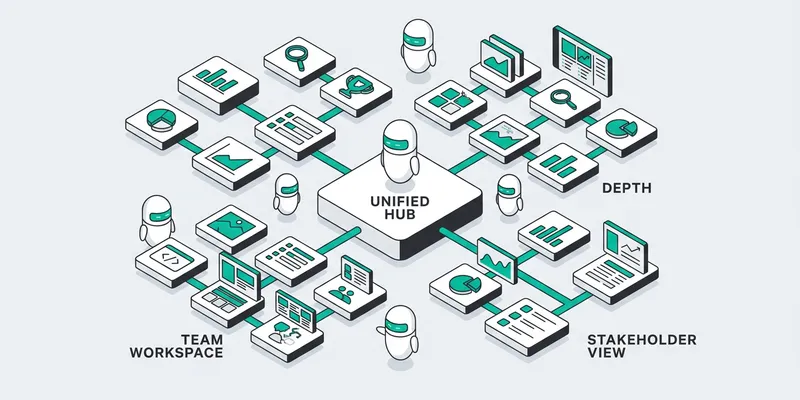
Identifying workflow bottlenecks in SEO processes
Single white bot with teal visor analyzing a pipeline of connected SEO process blocks, highlighting workflow constraints.
"The biggest challenge for SEO teams isn't finding opportunities, it's getting them implemented consistently."
— Lily Ray, SEO Director, Amsive Digital (2023)
A serious comparison should be honest about this. Semrush remains difficult to beat if your priority is breadth. It covers a lot of workflows under one roof. Agencies, in-house SEO teams with established processes, and organizations that need a shared analytics workspace can still get strong value from it.
It is also useful when leadership expects dashboards. Competitive snapshots, rank trend reporting, and market visibility views are easy to package for stakeholders. If you have the people and process to act on what the platform finds, Semrush does its job.
The issue is not that the tool is weak. The issue is that many teams have outgrown audit-first software without realizing it.
When to stop looking for a feature match
"The gap between SEO strategy and implementation kills more growth opportunities than bad keyword research ever will."
— Joakim Thörn, Founder, effectly.ai
A common mistake in any semrush alternative search is comparing tool pages line by line. Does it track this metric, crawl that many pages, export these reports, or monitor those SERP features?
That approach assumes the buying decision is about coverage. Often it is about throughput.
If your team already knows the technical debt, knows the content gaps, and knows the target pages that need work, adding another intelligence layer does not create leverage. It adds one more interface between problem detection and implementation.
This is the point where execution should become the primary evaluation criteria. Ask harder questions:
Can the platform write changes directly into the CMS or codebase?
Can it create, revise, and publish content based on actual audience and query intent instead of generic templates?
Can it remediate technical issues natively, without JavaScript overlays?
Can you approve changes, audit every action, and keep those fixes permanently?
If the answer is no, you are still buying diagnosis.
How to evaluate a semrush alternative for an execution bottleneck
Start with workflow, not features. Look at the last 90 days of SEO work that should have shipped but did not. Include technical fixes, content updates, internal linking changes, metadata rewrites, schema corrections , and net-new page production. Then trace where each task stalled. For many teams, the stalls are predictable. SEO identifies the issue. Content needs a brief. Someone waits for legal or brand review. Engineering has to touch templates. Another team owns the CMS. Weeks pass. Nothing changes on the site. A strong alternative should reduce handoffs. Ideally, it should collapse them....
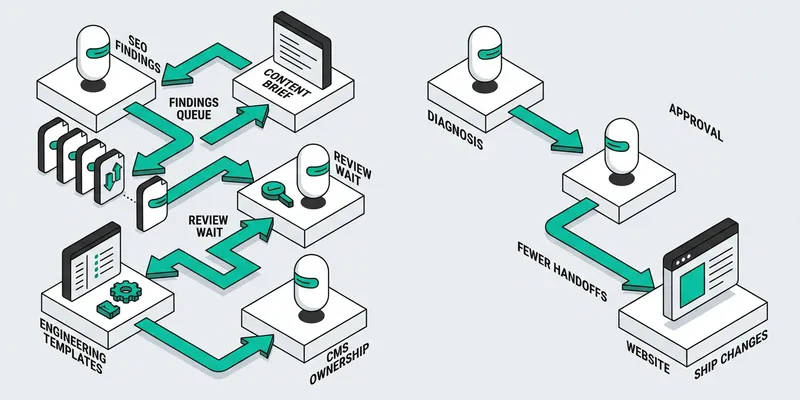
Balancing comprehensive data with actionable insights
White capsule bot operating an isometric balance scale weighing detailed analytics blocks against simplified execution blocks.
Start with workflow, not features. Look at the last 90 days of SEO work that should have shipped but did not. Include technical fixes, content updates, internal linking changes, metadata rewrites, schema corrections, and net-new page production. Then trace where each task stalled.
For many teams, the stalls are predictable. SEO identifies the issue. Content needs a brief. Someone waits for legal or brand review. Engineering has to touch templates. Another team owns the CMS. Weeks pass. Nothing changes on the site.
A strong alternative should reduce handoffs. Ideally, it should collapse them.
This is why the next generation of platforms is less about finding problems and more about owning the work. Effectly.ai is one example of that shift. It is not positioned as another SEO reporting layer. It runs the organic search workflow end-to-end, making permanent, native changes to the site through API, SSH, or Git-based connections. That is a different category from Semrush, and for the right buyer, it is the more relevant comparison.
The distinction is practical. A dashboard can tell you 600 pages have weak internal linking. An execution engine can fix the internal links. A crawler can flag thin category content. An execution system can write, review, and publish the content directly into the CMS. A reporting suite can show duplicate metadata across templates. An execution-first platform can remediate the pattern at the source.
That is the benchmark worth using.
The trade-offs between data depth and action
There is no perfect replacement because the categories solve different problems.
Research-first platforms typically have deeper competitive databases and broader visibility tooling. If your SEO program is strategy-heavy and operationally mature, that matters. Execution-first systems may be less focused on giving your team another way to inspect the market and more focused on shipping work continuously.
This is not a minor trade-off. It affects who should buy what.
If your team runs sophisticated competitor modeling, frequent market research, and analyst-level reporting, keeping a research platform in the stack may still be justified. If your issue is that known work is not getting done, an execution layer will usually have more impact than adding reporting depth.
Many companies will end up with a hybrid answer. They keep one source of search intelligence and replace manual SEO operations with an execution engine. That is a cleaner setup than expecting a single tool to satisfy both advanced research and hands-free implementation.
The wrong reason to switch
Do not switch because you want a cheaper version of the same dashboard. That usually ends with feature loss and the same operational constraints.
Switch because your current setup no longer matches the limiting factor in your growth model.
If the limiting factor is insight, choose the platform with the best data for your market. If the limiting factor is publishing velocity, technical implementation, and content production across an overloaded team, choose the system that closes the loop.
That is the standard mature teams should use. Not how many widgets fit on the screen. Not how many audit categories exist. Not who has the prettier interface.
SEO software is changing shape. The old model surfaced issues and waited. The newer model acts. Teams that understand that shift will stop shopping for another toolbox and start buying throughput.
A useful closing test is simple: if your current platform disappeared tomorrow, what work would stop getting done? If the answer is reporting, replace reporting. If the answer is nothing was getting done anyway, stop buying more visibility and start buying execution.
FAQ
What makes effectly.ai different from Semrush for team workflows?
Effectly.ai focuses on automated SEO implementation and developer integration, while Semrush primarily provides research data and reporting. Effectly.ai pushes changes directly to your codebase, eliminating the manual handoff between SEO teams and developers that creates bottlenecks.
Can I use effectly.ai alongside Semrush for research?
Yes, many teams use Semrush for competitive research and keyword discovery, then use effectly.ai for automated implementation. This combination gives you comprehensive research capabilities plus execution automation. Effectly.ai integrates with popular research tools to streamline this workflow.
How does effectly.ai handle technical SEO compared to Semrush's site audit?
Semrush identifies technical issues through audits, but effectly.ai automatically fixes many common problems like meta tags, schema markup, and internal linking. Instead of generating reports about issues, effectly.ai implements solutions directly in your codebase through GitHub integration.
What's the cost difference between effectly.ai and Semrush for teams?
Effectly.ai typically costs less than Semrush's team plans while delivering higher ROI through automation. Teams save 15-20 hours per week on manual SEO tasks, making the productivity gains significantly more valuable than the subscription cost difference.
Does effectly.ai provide keyword research like Semrush?
Effectly.ai focuses on implementation rather than keyword research. For comprehensive keyword data, teams often pair effectly.ai with research tools or use Semrush for discovery and effectly.ai for execution. This division of labor maximizes both research depth and implementation speed.
How quickly can teams migrate from Semrush to effectly.ai?
Migration focuses on workflow changes rather than data transfer since the tools serve different purposes. Teams can integrate effectly.ai within 1-2 weeks while maintaining existing research tools. The GitHub integration and automated implementation features require minimal setup time.
What team size works best with effectly.ai versus Semrush?
Effectly.ai works best for teams of 2-20 people who need to execute SEO changes quickly without large development resources. Semrush suits larger teams with dedicated research roles and extensive reporting needs. Mid-market teams often benefit most from effectly.ai's execution focus.